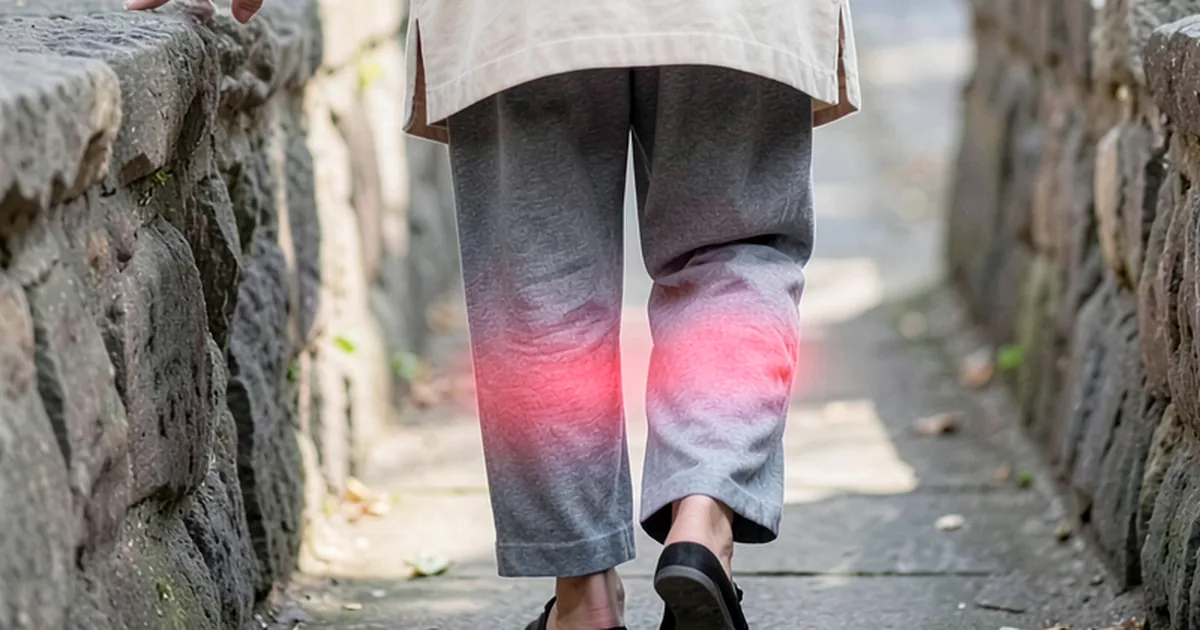
If you walk a certain distance and then have to stop because of pain, numbness, or heaviness in your legs, doctors call this intermittent claudication. It has two main causes that are completely different: pressure on the nerves in the lower back, or narrowing of the arteries in the legs. Telling them apart is the first step in treatment, because it decides which specialist you need: a neurosurgeon or a vascular surgeon.
What is intermittent claudication?
Claudication is pain or fatigue in the legs that comes on with walking, forces you to stop, and then settles with rest so you can walk again.
Patients describe it in different ways: legs that feel "heavy", legs that "go numb and give way", or a calf that "cramps up". What they have in common is a limited walking distance that often gets shorter over time.
What is neurogenic claudication?
Neurogenic claudication comes from pressure on the nerves inside the spinal canal in the lower back. When you stand up straight and walk, the canal narrows further and symptoms build; when you sit or bend forward, it opens up slightly and the nerves get relief.
Its most common causes are:
- Age-related lumbar spinal stenosis, caused by thickened joints and ligaments
- Spondylolisthesis, where one vertebra slips forward over another
- A large herniated (slipped) disc in some cases
Spondylolisthesis is not the same as a slipped disc: the first is a slip of the vertebra itself, the second is a bulge of the cushion between two vertebrae.
What is vascular claudication?
Vascular claudication is caused by narrowing of the arteries in the legs (peripheral arterial disease), so the muscles don't get enough blood when they work.
At rest, a muscle needs little blood, but walking raises its demand, and if the artery is narrowed, pain appears, usually in the calf. The main risk factors are smoking, diabetes, high blood pressure, high cholesterol, and age.
How can I tell neurogenic from vascular claudication?
The simplest difference: vascular claudication settles as soon as you stand still, while neurogenic claudication needs you to sit down or bend forward.
- How you get relief: with vascular claudication, standing still for a minute or two is enough. With neurogenic claudication, you need to sit or lean forward.
- Back position: neurogenic claudication often eases when cycling or walking bent over a shopping trolley or a stick. Vascular claudication doesn't change with back position.
- Walking uphill: going uphill makes vascular pain worse because the effort is greater, but can be easier with neurogenic claudication because the body leans forward.
- What it feels like: neurogenic claudication is usually numbness, heaviness, or tingling running down from the back or buttocks. Vascular claudication is usually a cramp-like pain in the calf.
- The foot: in vascular claudication the foot may be cold, the skin shiny, and the foot pulses weak or absent.
Can both causes exist together?
Yes, and it isn't rare after sixty. The age at which spinal stenosis appears is the same age at which arteries harden, especially in smokers and people with diabetes.
Before deciding on spinal fixation surgery for a woman in her sixties with leg pain on walking, we first made sure her arteries were not the cause. A back operation won't fix pain caused by a blocked artery, and the reverse is also true. You can read her story and how she walked without stopping again after spinal fixation.
In my clinic, a spine scan alone is not enough when a patient tells me the foot feels cold, has noticed a change in its colour, or the pain came on suddenly. Those details make me suspect the arteries, so I check the foot pulses and request a Doppler before any decision about back surgery.
Which tests identify the cause?
Diagnosis starts with your history and an examination, then specific tests confirm it.
- Checking the foot pulses and comparing blood pressure at the ankle and the arm (the ankle-brachial index): a simple test that reveals narrowed arteries.
- Arterial Doppler ultrasound: shows where the narrowing is and how severe.
- Lumbar spine MRI: shows spinal stenosis or spondylolisthesis and how much the nerves are compressed.
- Flexion and extension X-rays of the spine: show whether the slipped vertebra moves.
When should you see a doctor urgently?
Some signs cannot wait:
- A cold, pale, or bluish foot with pain at rest, especially at night
- A wound on the foot that won't heal, or a change in the colour of the toes
- Leg weakness that is getting worse, or tripping while walking
- Loss of bladder or bowel control, or numbness around the back passage and genitals
The first two need a vascular surgeon urgently; the last two need a neurosurgeon urgently.
How is neurogenic claudication treated?
Most cases start with non-surgical treatment: medication for pain and nerve symptoms, physiotherapy to strengthen the core and back muscles, and adjustments to walking and daily activity.
Surgery becomes the better option when this treatment fails and your walking distance shrinks until daily life stalls, or when nerve weakness is getting worse. The aim of surgery is to free the compressed nerves, and when spondylolisthesis is unstable, the vertebrae are also fixed with screws. The Spine & Peripheral Nerve Surgery page explains these options in detail.
Vascular claudication is treated by a vascular surgeon and includes stopping smoking, regular walking, controlling blood sugar, blood pressure, and cholesterol, medication, and sometimes widening the artery or bypassing it. To learn which signs make back pain itself an emergency, read When does back pain need urgent attention?.
Book an appointment
If leg pain is shortening the distance you can walk, the right diagnosis is what points you to the right specialist and the right treatment. Book an assessment at the clinic in El Bagour, Menoufia, through our contact page, or read more about Spine & Peripheral Nerve Surgery.